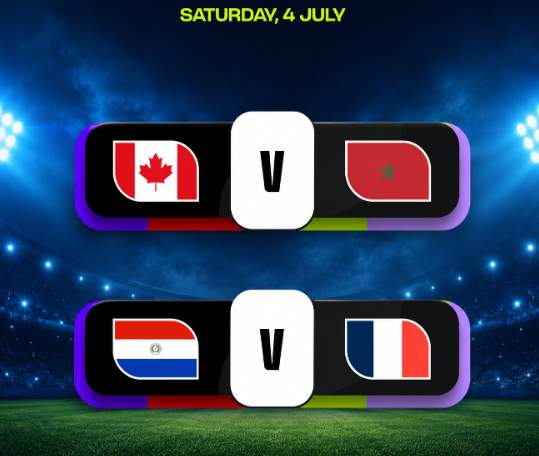
On July 4, 2026, the FIFA World Cup enters its Round of 16 phase with two matches. Canada faces Morocco at NRG Stadium in Houston, with kickoff scheduled for around 1 p.m. ET. Later that day, Paraguay takes on France at Lincoln Financial Field in Philadelphia, starting near 5 p.m. ET. These games connect directly to the group stage results, where teams advanced based on points, goal difference, and tiebreakers. The winners move to the quarterfinals, while the losers exit the tournament.
Canada and Morocco both reached this stage through late drama. Canada secured advancement with a stoppage time goal from Stephen Eustaquio against South Africa. Morocco advanced past the Netherlands on penalties after a 91st minute equalizer. This link between their paths shows how both teams rely on resilience in tight moments. Canada, coached by Jesse Marsch has built organization and counter attacking options. Key players include Alphonso Davies on the left, if fully fit after injury concerns, alongside forward Jonathan David and midfielders like Stephen Eustaquio and Nathan Saliba. Their setup often uses a back four with width from Tajon Buchanan and Liam Millar. Canada’s prospects depend on limiting Morocco’s transitions and creating chances through David’s movement.
Morocco enters with experience from their 2022 semifinal run. Coach Mohamed Ouahbi fields a side with defensive solidity and quick attacks. Goalkeeper Bono anchors the back line, supported by Achraf Hakimi at right back. Midfielders such as Azzedine Ounahi and Neil El Aynaoui provide control, while Brahim Díaz and Ismael Saibari add creativity up front. Morocco’s tactical approach connects strong pressing with counter opportunities. They stand as favorites due to depth and familiarity with high stakes games, though Canada’s home soil energy and organized structure could make the match competitive. A low scoring affair seems likely, with Morocco’s set piece threat and individual quality offering an edge.
In the second match, France faces Paraguay. France topped their group with consistent performances and now carries knockout expectations. Kylian Mbappe leads the attack and holds a strong record in World Cup knockout stages. Michael Olise has stood out with assists, linking play from midfield or wide areas. Ousmane Dembele provides pace on the flanks, while the defense features William Saliba and Dayot Upamecano. Coach Didier Deschamps typically deploys a 4-2-3-1 formation. Injuries to players like Aurelien Tchouameni shift responsibility to others such as Adrien Rabiot or Manu Kone in midfield. France’s prospects center on controlling possession and exploiting spaces behind Paraguay’s defense.
Paraguay arrives as underdogs but with a compact 5-3-2 or similar setup under coach Gustavo Alfaro. They emphasize defensive organization and quick breaks. Julio Enciso and Miguel Almiron offer attacking threat from forward positions, with Matías Galarza and Diego Gomez supporting in midfield. Players like Gustavo Gomez add experience at the back. Paraguay’s path links to disciplined defending seen in prior tournaments. Their chances rest on frustrating France and capitalizing on any lapses, though France’s quality in transition and set pieces creates a clear connection to a likely advancement for the European side.
These July 4 matches tie into the broader tournament bracket. The Canada-Morocco winner faces the France-Paraguay victor in the quarterfinals. France holds the strongest overall profile based on squad depth and recent form, while Morocco brings proven knockout pedigree. Canada and Paraguay represent sides that have grown through the group stage and could produce surprises if they execute their plans. The day’s action highlights how individual performances, such as Mbappe’s finishing or Hakimi’s defensive work, connect to team outcomes in this single elimination phase.